


Mid-nineteenth century London, then the beating heart of the British Empire, was the most populous city in the world. With the Underground system and cars still years off, the two million people living in the bustling metropolis would get around the city in a variety of horse-drawn vehicles, from small and agile ‘Hansom cabs’ to the multi-passenger omnibus, all pulled hither and yon by a fleet of up to 300,000 horses.
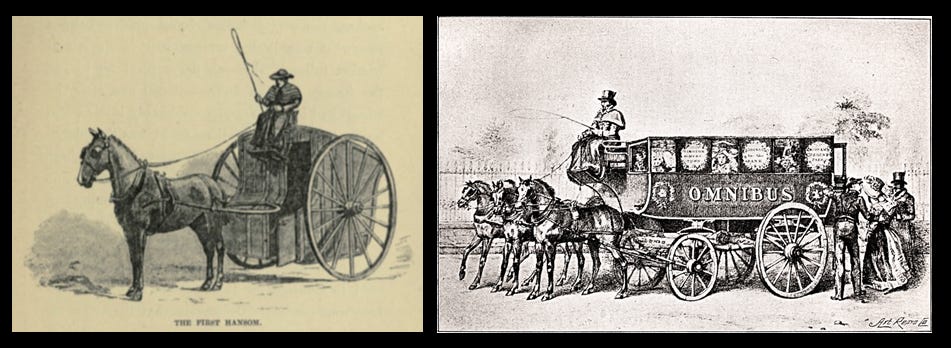
Fatal accidents on the increasingly congested streets of the capital were commonplace, and so policemen were drafted in to regulate traffic and prevent collisions. Recognising the limited visibility of a solitary policemen amidst the flurry of carriages, railway engineer John Peake Knight came up with a solution.
Peake’s invention was a 22-foot high variant on the already established lamppost, adapted to incorporate the signalling system deployed on Britain’s ever-growing rail network. At the very top sat a gas-powered lantern; attached just beneath were two mechanical arms. The tall, hollow iron pillar housed a mechanism that connected a lever at the base to both the lantern and the arms: pulling the lever one way caused the arms to rise into a horizontal position, while simultaneously rotating the lantern head; pushing the lever back to its start position reversed these actions.
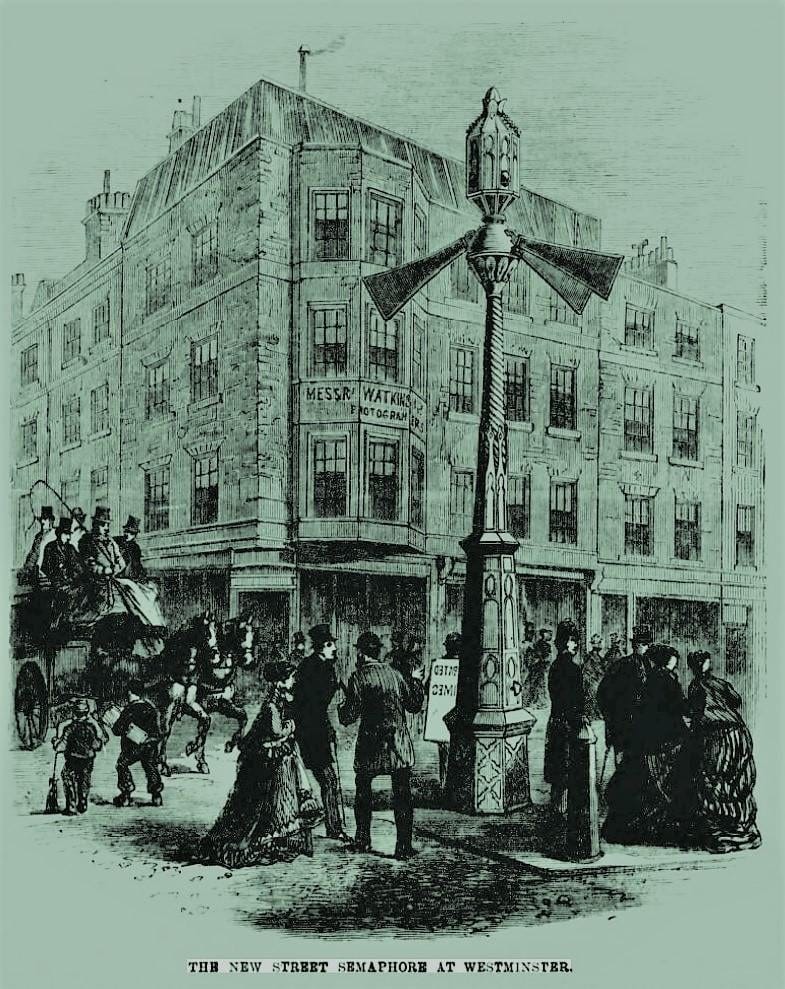
During daylight hours, Peake’s contraption issued commands in exactly the same manner as signals on railway lines, via semaphore: arms raised in a horizontal position meant ‘halt’, while arms lowered at 45 degrees meant ‘go’.
After sundown, with the arms scarcely visible, the gas lamp would be lit, the flame burning inside a four-sided lantern featuring red glass plates on two opposing faces, and green plates on the others. With a yank of the lever, the lantern rotated 90 degrees, alternating between red and green in the direction of traffic.
The first of Peake’s “street semaphores” was put up on 9 December 1868 at one of the most dangerous intersections in London, a junction just outside the Houses of Parliament in Westminster that had recently seen a policeman killed, and two MPs hit and badly injured, by speeding horse carriages.
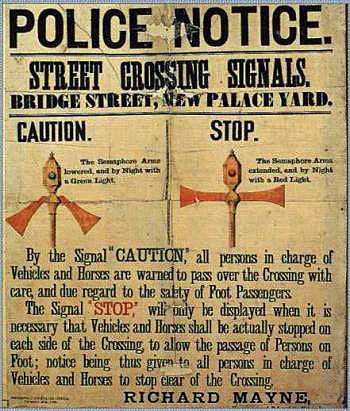
The street semaphore, operated by a police officer, had a mixed debut. While some road users got the hang of it quickly, others did not. London’s newspapers were likewise split over this new feature in Parliament Square. Then, just a month after it had been installed, the gas powering the lights ignited and the pillar exploded, its hapless operator receiving severe facial burns.
Despite Peake’s optimism that his street semaphores would rapidly spread around the city, plans to use them more widely were dropped immediately. But Peake had unleashed the idea of using lights to regulate road traffic. Forty years later, with the advent of the petrol-powered car, his street semaphore would return to London, minus the mechanical arms, as the electrically powered traffic light.